Public Realm Improvements and Big-Picture Visioning Should Drive BQE Central Rehabilitation
Keri Butler, president of the Municipal Art Society of New York issued the following statement about the Mamdani administration’s plans for the BQE Central rehabilitation:
The Municipal Art Society of New York commends the Mamdani administration for advancing critical repairs to the deteriorating central portion of the Brooklyn-Queens Expressway (BQE Central). We are also pleased that the administration has discarded previous plans to enlarge the expressway from two to three lanes.
However, we urge the Mamdani administration to pair this essential work with improvements to the public spaces along the BQE and a long-term plan to remedy the generations of harm caused by the Moses-era project in Environmental Justice neighborhoods along this interborough corridor.
The City must ensure that repairs undertaken in the short-term do not preclude future transformational interventions to reconnect neighborhoods, such as capping the trenched sections through Carroll Gardens and leveling the portions through Williamsburg to create an at-grade route, both with park space and climate-focused designs. The infrastructure repaired today will undoubtedly inform the landscape of possibilities over the decades to come. It is critical that the design and engineering of the current $4 billion project preserve the possibilities for alternative thinking with future State and Federal collaboration.
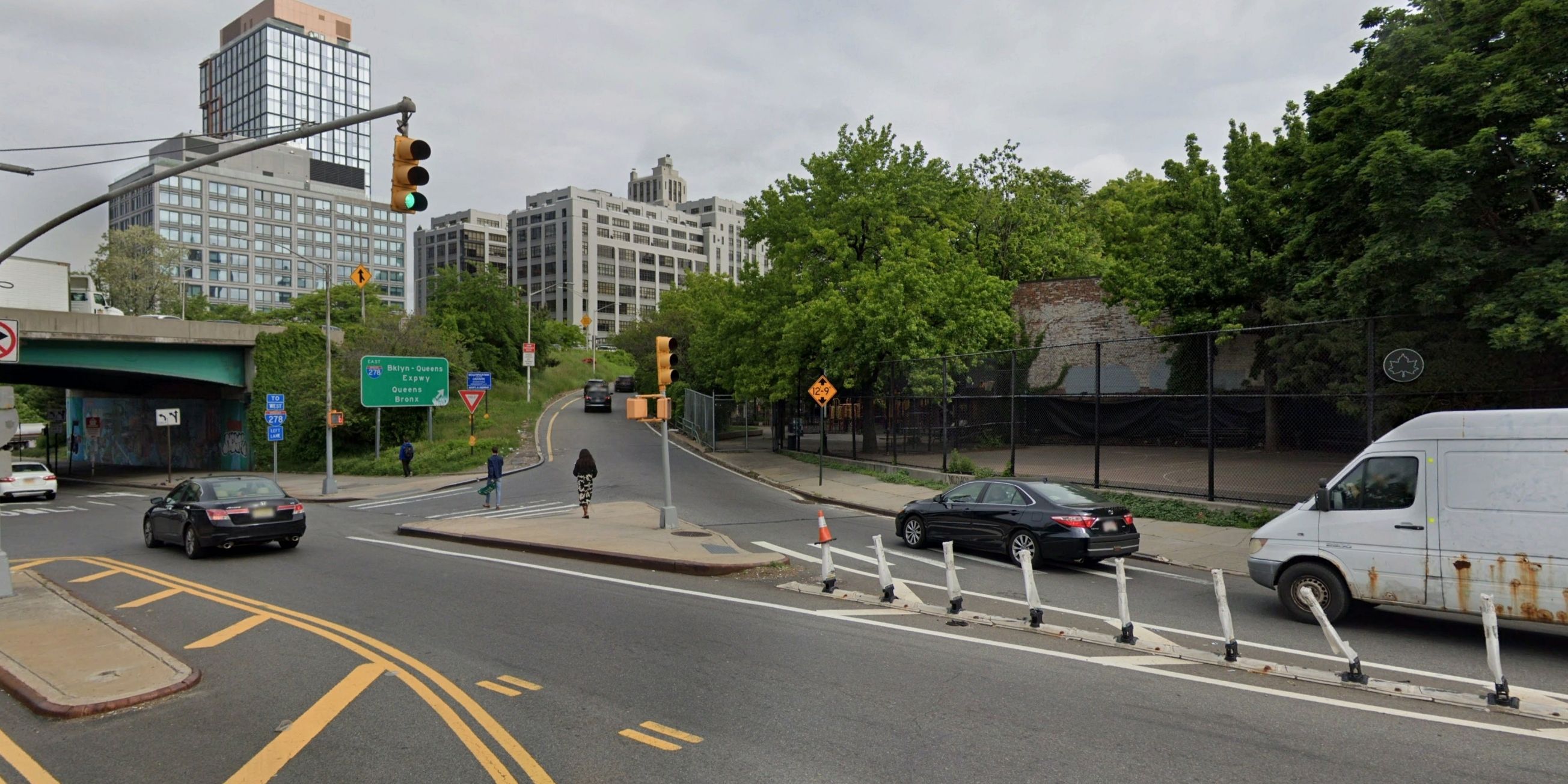
Further, MAS sees significant opportunities to deliver public realm improvements within the scope of the current BQE Central rehabilitation. The Mamdani administration has the chance to maximize the public benefit of every dollar invested by leveraging the project to improve the BQE Central’s connections with local arterials and its footprint in adjacent open spaces. Focus should be given to the Atlantic Avenue and Brooklyn Bridge connections, which pose serious safety concerns for all multimodal users, and at the on-ramps that pass through Adam Yauch Park, Van Voorhees Park, and Clumber Corner. In addition, green infrastructure to mitigate stormwater flooding and urban heat should be integrated wherever feasible to ensure a climate-ready and future-prepared project.
The Atlantic Avenue BQE connection merits special attention given the history of serious crashes and pedestrian fatalities. The City must prioritize pedestrian safety and connectivity by (1) removing the west-bound slip lane, (2) adding protected bicycle lanes to Bridge Park Drive, and (3) implementing traffic demand management tools to reduce conflict areas. MAS also urges the City to revisit recommendations we jointly outlined in the BQE Expert Panel Report, published in January 2020, including studying the restriction or full closure of BQE on-ramps at the Atlantic Avenue and Brooklyn Bridge entrances to improve safety and reduce traffic volumes.
Finally, the City must also be transparent about how the temporary Furman Street bypass will impact Brooklyn Bridge Park access, the Promenade, and the other open space adjacent to the project. We urge the Department of Transportation (DOT) to share a clear plan for how the project will impact both access to- and design of- parkland within and abutting the scope line.
Copyright Google 2026. Modifications: cropped.
The Mayor is right: the City has kicked the can on the BQE for too many years, and now it must make urgent safety repairs. However, without simultaneously pushing forward a more expansive vision for the BQE in collaboration with the State, we are missing a once-in-a-generation opportunity. Within the scope of the BQE Central there is clear potential for infrastructure and public realm improvements along the City-owned corridor and at the Atlantic Avenue and Brooklyn Bridge nodes.
Together, seizing these opportunities would enhance safety and connectivity along Atlantic Avenue, strengthen connections between Brooklyn Heights, Cobble Hill, and Brooklyn Bridge Park, support neighborhood integration with the forthcoming Brooklyn Marine Terminal redevelopment, and lay the groundwork for future transformational change throughout the BQE corridor.
Help us continue our planning advocacy on behalf of New York City.
Donate