The Social Life of Small Urban Spaces

In Partnership with Low Cinema
The Municipal Art Society (MAS) is thrilled to be co-presenting The Social Life of Small Urban Spaces with Low Cinema in Ridgewood, Queens this winter. The film will be screened between Friday, January 16 and Wednesday, January 21. The 2K restoration is courtesy of Anthology Film Archives, MAS, and the Project for Public Spaces.

The 5:30PM screening on Sunday, January 18, will be followed by a conversation between Keri Butler, Nicholas Bloom, and Seth Kerr, moderated by Amy Sohn and Katie Honan.

Keri Butler is the President of the Municipal Art Society of New York (MAS), a civic advocacy organization that originally produced the film when William H. Whyte was on the MAS board.

Nicholas Bloom is the Acting Chair of the Department of Urban Policy & Planning at Hunter College, City University of New York.

Seth Kerr is a Project Manager with Port Authority’s World Trade Center Department, where he leads the 16-acre campus’s Public Realm and Placemaking Program.

Katie Honan is a senior reporter at the online news site The City and a co-host of FAQ NYC.

Amy Sohn is the author of 13 books including The Man Who Hated Women: Sex, Censorship, & Civil Liberties in the Gilded Age. She cohosts The City’s LIT NYC podcast, which recently had an episode on The Social Life of Small Urban Spaces.

The 5:30 PM screening on January 18 is SOLD OUT, but tickets are still available for other screenings, so buy tickets below! Questions? Email us at events@mas.org.

Sunday, January 18
5:30 PM — 7:00 PM

Low Cinema
70-11 60th Street
Ridgewood, NY 11385

Tickets:
Member: $15
Non-member: $15

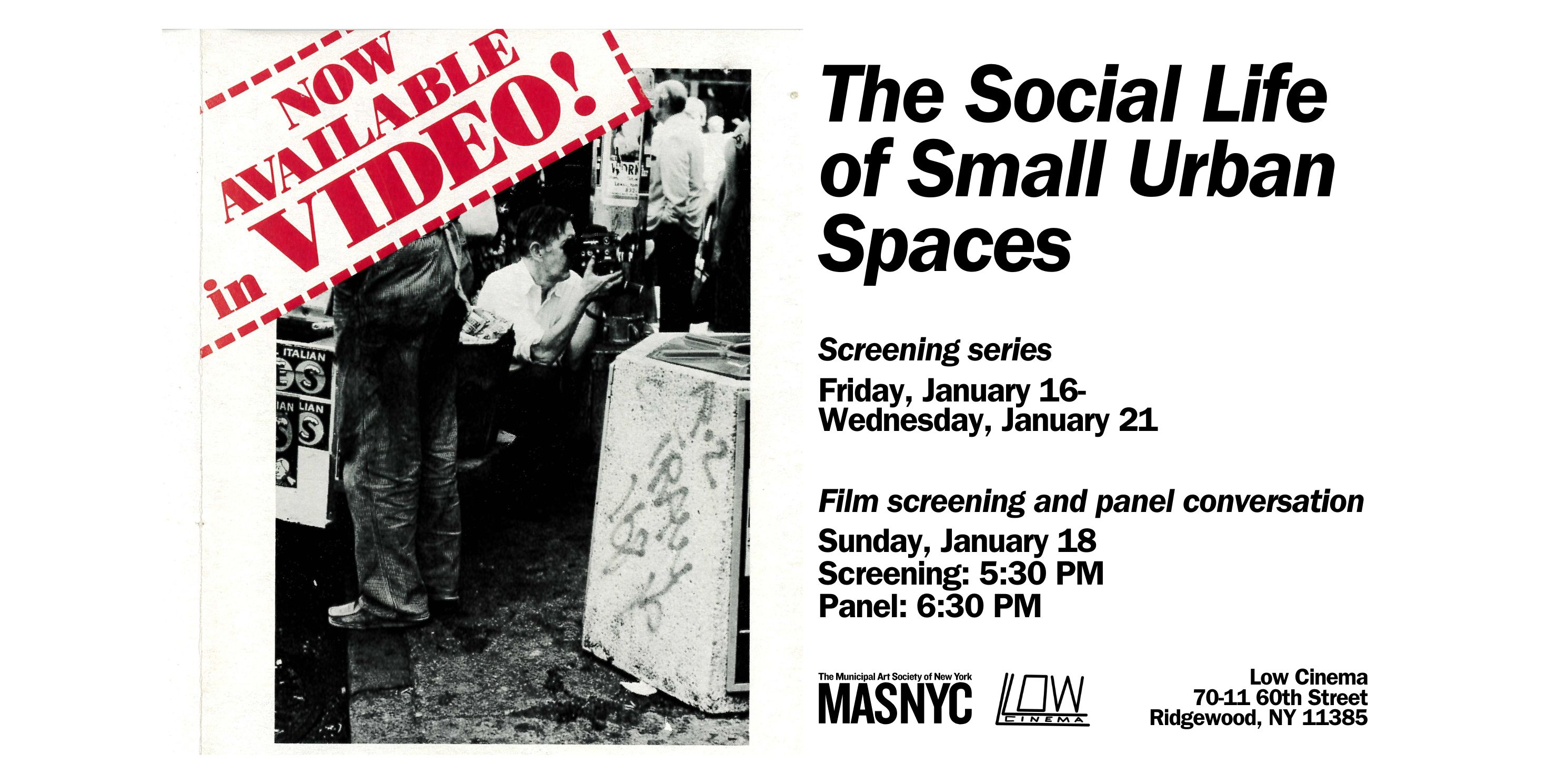
A brochure printed by the Municipal Art Society in the early 1980s, promoting William H. “Holley” Whyte’s film The Social Life of Small Urban Spaces. Credit: The Municipal Art Society of New York Archives.

“When Anthology Film Archives first screened The Social Life of Small Urban Spaces in 2023, the only available copies were VHS-quality video transfers made from significantly faded 16mm prints, with pronounced magenta shift. It became clear that the beloved film deserved a far better presentation.

We began searching for unfaded film elements, but this proved challenging. Although we located numerous 16mm prints in libraries and archival collections, all exhibited significant color fading—an issue common to prints produced during the period in which William H. Whyte made his film.

With the assistance of Project for Public Spaces and the Municipal Art Society of New York, we ultimately gained access to what turned out to be the only known unfaded element in existence: William H. Whyte’s personal 16mm print, fortuitously struck on special “low-fade” print stock. This print was scanned in 2K and underwent extensive digital color correction, allowing Social Life… to be revived in a form worthy of this singular and historically significant work.”

– John Klacsmann, Anthology Film Archives